Ride-Hailing Fraud: Detect Off-Platform Trips With Fleet Signals
Customer story: TE Cars VIP (≈100 vehicles)
In ride-hailing, losses are not always visible as a single incident. More often, they appear as persistent operational gaps: revenue that does not align with observed vehicle activity, missed bonus targets, and management time diverted into repeated dispute resolution rather than operational improvement.
This was the situation at TE Cars VIP, a fleet of roughly 100 vehicles operating on platforms such as Uber and Yango. The team faced a recurring issue: some drivers were completing trips outside the company’s official platform accounts—using alternative accounts or accepting rides that did not appear in enterprise reporting.
The impact was direct:
- Undeclared revenue: trips occurred, but were not captured through the company accounts
- Bonus leakage: incentives tied to official accounts did not accrue as expected
The core challenge was not recognizing the risk. It was establishing evidence that is objective, repeatable, and fair, without turning day-to-day operations into an investigation function.
When the Vehicle Is Active, but the Account Remains Quiet
Off-platform usage can be difficult to isolate because it is often indistinguishable from legitimate operational explanations: repositioning, breaks, traffic delays, refuelling, or maintenance. Individually, any of these may be valid.
However, patterns can emerge over time. TE Cars VIP observed vehicles remaining active over extended periods—circulating in high-demand areas and exhibiting repeated stop patterns consistent with pickups and drop-offs—while the official platform accounts showed limited or no activity during the same windows.
This mismatch creates an operational dilemma:
- Ignore it, and leakage becomes embedded in normal performance
- Act on intuition, and the organisation risks undermining trust and pressuring compliant drivers
TE Cars VIP therefore needed a third approach: evidence-based review.
Flott’s Approach: Reconcile Platform Trips With Fleet Signals
Flott addresses the problem as a reconciliation exercise rather than surveillance: comparing recorded platform activity with observed vehicle activity.
1) Establishing a Reliable Activity Baseline From Fleet Signals
Fleet signals—time, location, movement, and stops—provide a consistent view of vehicle activity. Flott aggregates these signals into operational segments that show when a vehicle was moving, where it remained stationary, and how activity clusters over time.
2) Aligning Vehicle Activity With Platform-Recorded Trips
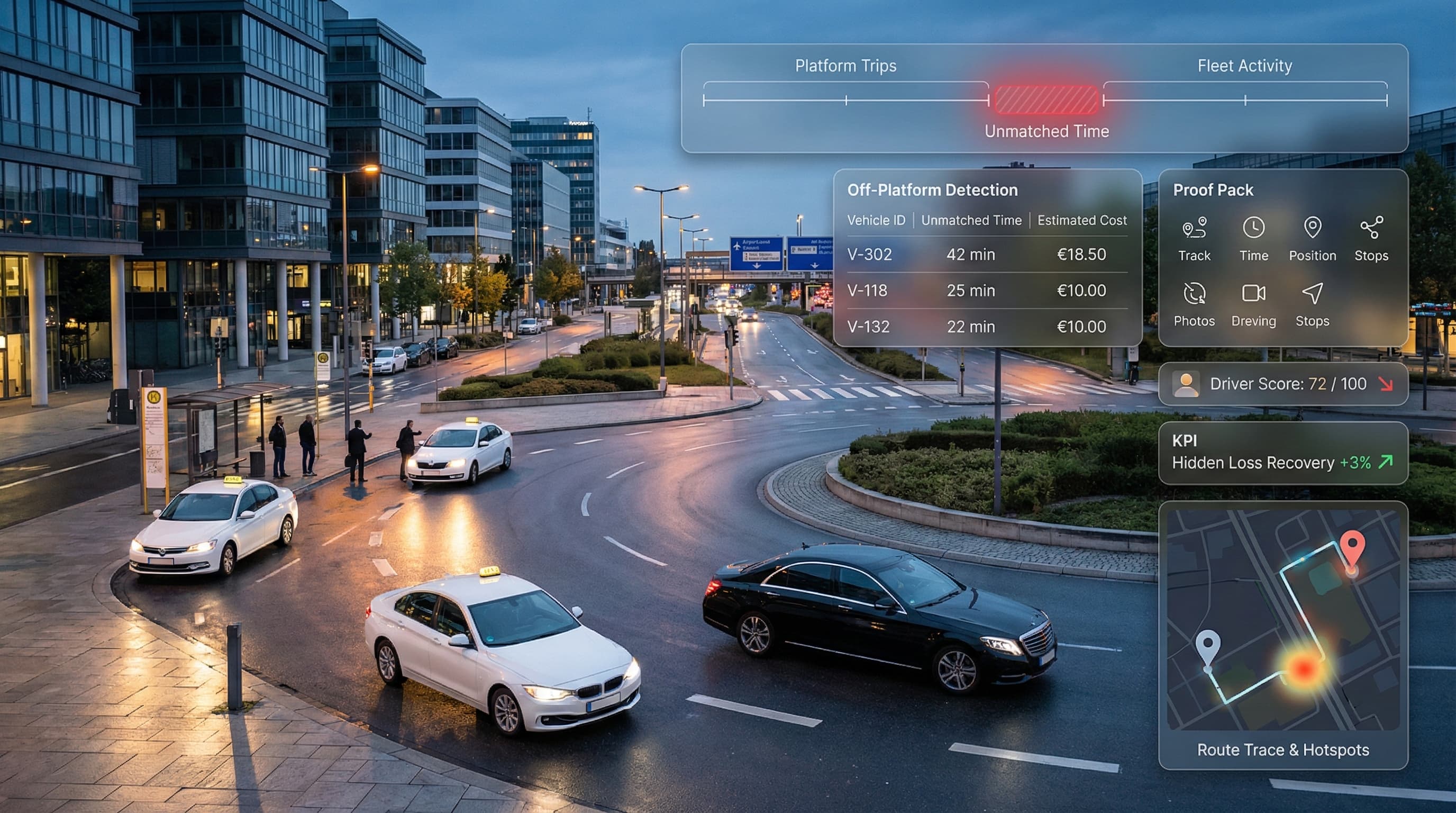
Flott then reconciles vehicle activity against trip activity recorded on the company’s Uber/Yango accounts. The outcome is structured to support review:
- Matched time: vehicle activity that corresponds to recorded platform trips
- Unmatched time: vehicle activity without a corresponding platform record
Unmatched time is not, by itself, proof of fraud. It is, however, a meaningful indicator of where revenue leakage can occur and where review may be warranted.
3) Identifying Off-Platform Windows Using Consistent Rules
Flott surfaces higher-confidence windows of potential off-platform usage while filtering common operational noise (fuel stops, traffic, short idle periods, repositioning). At the scale of ~100 vehicles, consistent treatment matters: manual checks do not scale, and inconsistent application can erode trust.
4) From Suspicion to a Structured Evidence Pack
When a window is flagged, Flott compiles the elements needed to review it in a consistent, case-based format:
- Route trace and timeline
- Start/end time and total duration
- Key locations and recurring clusters
- Stop/dwell behaviour (useful to distinguish breaks from activity)
- Vehicle and driver context tied to the relevant period
This changes the internal discussion from subjective debate to fact-based review: “here is the observed vehicle activity during the window.”
5) Estimating Business Impact With ~99% Reporting Precision
Once unmatched/off-platform time is identified, Flott estimates the business impact for TE Cars VIP with ~99% precision in reporting—translating the gaps into measurable losses (undeclared revenue and missed bonus performance).
The outputs are presented for operational use: breakdowns by driver, by vehicle, by week/month, and prioritisation by severity to support targeted action.
Driver Scoring Designed for Operational and HR Use
Isolated anomalies are expected in fleet operations. What matters is whether a pattern forms.
Flott generates a driver score based on observable trends:
- Frequency of high-confidence unmatched windows
- Duration and operational context
- Whether the pattern is improving or worsening over time
For TE Cars VIP, this supported more targeted responses—coaching where appropriate, escalation where evidenced, and protection for compliant drivers who should not be impacted by broad, suspicion-based policies.
Deployment: Operationally Practical by Design
A key requirement for TE Cars VIP was to avoid a prolonged IT project. Deployment was therefore conducted within the Flott tracking platform, leveraging existing integrations and enrichment required for this use case.
In practice:
- Onboarding was completed in a single 1-hour working session once access was in place
- The workflow is organised around table-like operational views for quick navigation
- Teams moved from “suspected” cases to “documented” cases without adding complexity to daily routines
Results: Revenue Protection and a More Transparent Operating Environment
Reducing Hidden Losses
By identifying and addressing off-platform usage, TE Cars VIP reduced undeclared activity and restored more trips to official reporting—supporting ~+3% revenue uplift through reduced leakage and improved platform performance.
Supporting Retention Through Fair, Evidence-Based Processes
Fraud detection also affects retention. High-performing drivers are less likely to stay in environments perceived as arbitrary. With evidence-based workflows, TE Cars VIP was able to:
- Retain strong drivers
- Set clear expectations without excessive monitoring
- Reinforce a culture of honesty and transparency, grounded in verifiable information
The Enterprise Takeaway
Ride-hailing fraud is not only a driver behaviour issue; it is also a reconciliation issue.
When observed fleet activity and platform reporting diverge, businesses lose twice: undeclared revenue and missed bonuses linked to official account performance. Flott helps close this gap through a disciplined loop—detect → document → quantify → act—designed to be deployable quickly and usable by operations and HR teams.
Key Takeaways
- Off-platform usage can resemble legitimate operational activity; patterns and evidence enable fair decisions
- The method is reconciliation, not surveillance: comparing vehicle signals with platform records to identify unmatched time
- Structured evidence packs support consistent review and reduce reliance on subjective judgement
- Driver scoring based on observable trends protects compliant drivers while prioritising higher-risk cases
- Results: ~+3% revenue uplift, reduced hidden losses, and a more transparent driver culture