Stop Car Rental Revenue Leakage: How M&N Inc. Reconciles Contracts With Real Usage
M&N Inc. operates a 25-car rental fleet—an environment where operational focus shifts quickly between availability during peaks and utilization during slower periods. In practice, one issue often sits between these priorities and is frequently managed reactively: billing accuracy.
Not due to a lack of diligence, but because rental operations rarely match contract conditions perfectly.
Late returns, mileage overages, out-of-zone activity triggering penalties, and road tickets received after the rental is closed are common examples. Individually, these exceptions are manageable. Over time, they can accumulate into material revenue leakage and create customer friction—particularly when charges cannot be supported with a clear evidence trail.
At M&N, disputes followed a consistent pattern: the question was less about the amount and more about certainty. “Why am I being charged this?” requires more than operational context; it requires verifiable records.
The Three Areas Where Revenue Typically Leaks
Across rental operations, billing leakage tends to concentrate in a small number of recurring categories. At M&N, the primary sources were the following.
Extra Mileage
Mileage allowances are straightforward to define in a contract and difficult to enforce consistently in day-to-day operations. Odometer photos, manual logs, and non-standardized handovers can result in overages being missed—especially when vehicles need to be turned around quickly.
In addition, unbilled mileage has a second-order impact: it also affects fleet value over time, as higher mileage accelerates wear and reduces residual value.
Out-of-Zone Penalties
Zones exist for operational and compliance reasons, including insurance terms and cross-branch balancing. However, enforcement becomes inconsistent when detection relies on manual checks or customer self-reporting—making charges harder to apply systematically and easier to contest.
Road Tickets and Fees
Road tickets often arrive after the rental file is already closed. Assigning them to the correct contract can require reconstructing context through schedules, emails, and supporting documents. In some cases, tickets are re-billed; in many cases, they are not, because establishing certainty takes time.
What Changed: Reconciling Contract Terms With Usage Data
M&N did not require a new pricing model. The operational requirement was to reconcile what was sold with what actually occurred—without turning each rental into a manual investigation.
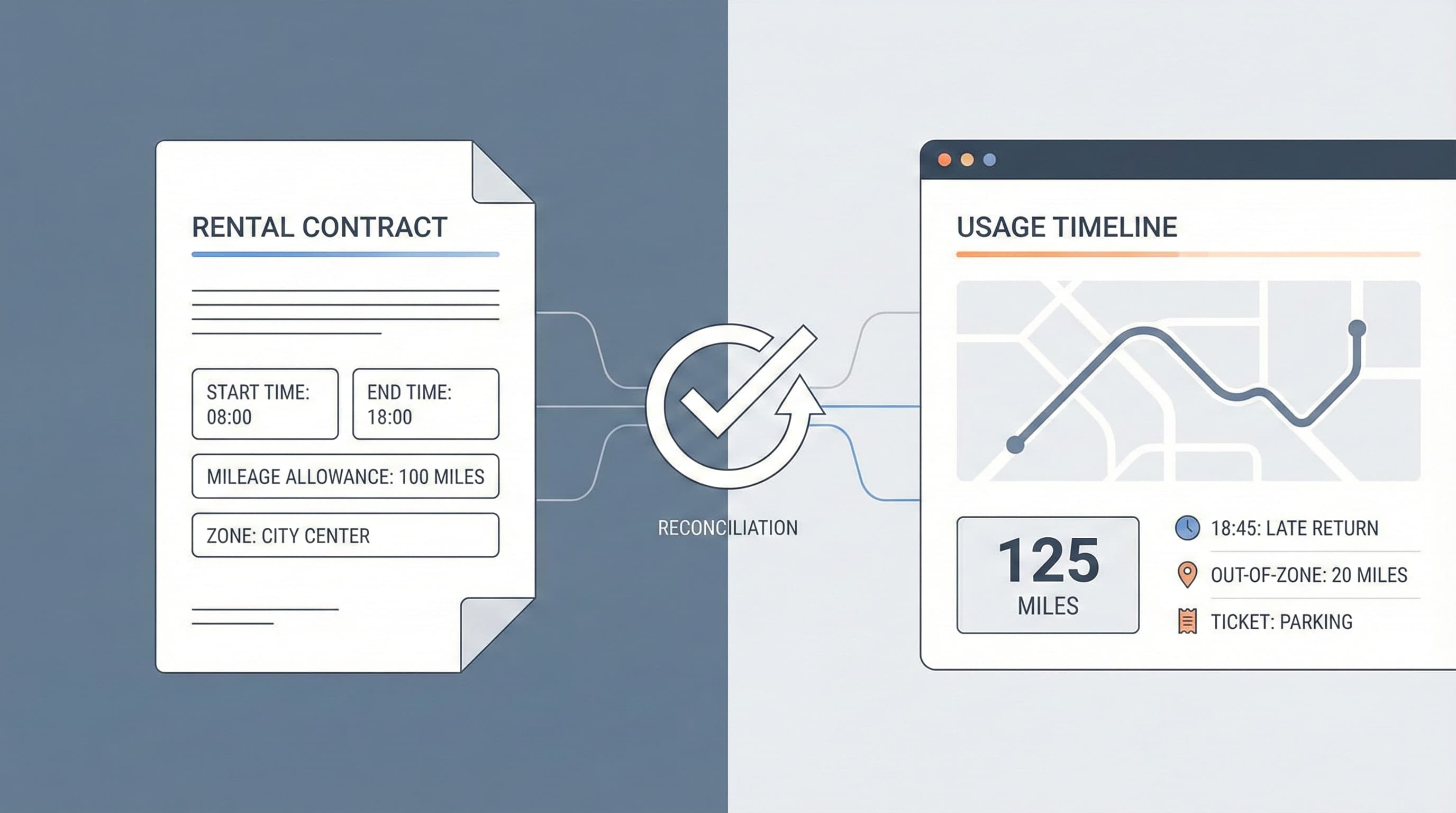
With Flott HQ, the team implemented a reconciliation workflow based on two layers reviewed together for each rental:
- Contract terms: duration, mileage allowance, zones, and fee rules
- Actual usage: time in service, mileage delta, location events, and exception triggers
The key change was not merely the availability of data, but the consolidation of contract and usage signals in the same workflow—reviewed in a consistent manner. This reduced reliance on post hoc checks and “we’ll confirm it later” billing.
One View Per Rental, With Supporting Evidence
For each rental, M&N now uses a table view designed to provide a clear audit trail, including:
- Contract start/end time versus actual timeline
- Mileage allowance versus observed mileage
- Zone rules versus detected out-of-zone events
- Ticket reconciliation status
- Supporting evidence attached to each exception
Operationally, this shifts exception handling from an ad hoc activity to a structured review process: exceptions appear as items to approve or reject, with the relevant context attached.
Invoicing On Demand, With Standardized Outputs
Once exceptions have been reviewed, invoices can be generated on demand through an AI-assisted workflow designed for consistency—itemized charges, standardized language, and evidence links where appropriate.
The objective is not to remove human judgment, but to reduce the manual steps that often introduce avoidable disputes: copy/paste work, manual calculations, and inconsistent descriptions. A human review step remains in place before invoices are sent.
For a 25-car fleet, these efficiencies are cumulative. M&N estimates it saves 8 hours per week by reducing manual reconciliation and post-issuance clarification.
Results: Revenue Recovered and Fewer Disputes
Within the first billing cycle, M&N recovered €8k that previously would likely have been missed, waived, or not billed due to insufficient certainty.
Beyond financial recovery, the more durable effect was improved customer confidence. With time, mileage, location, and event context attached to exceptions, billing discussions became shorter and less contentious—reducing reliance on subjective explanations and strengthening the defensibility of charges.
In car rental, accuracy is part of the customer experience—not because customers welcome fees, but because uncertainty undermines trust.
Why It Matters as Fleets Scale
As fleets grow, complexity increases faster than capacity: more vehicles, more locations, more handovers, and more exceptions. Billing issues often emerge not because contract terms are wrong, but because manual reconciliation becomes too costly and inconsistent at scale.
M&N’s approach provides a practical blueprint:
- Prioritize the exceptions that drive the most leakage
- Reconcile them using usage data
- Make invoices defensible by design
Key Takeaways
- Revenue leakage in car rental often originates from extra mileage, out-of-zone penalties, and late-arriving road tickets
- Manual reconciliation does not scale and increases disputes when evidence is incomplete
- A unified contract + usage view moves billing from “best effort” to an auditable trail
- AI-assisted invoicing reduces copy/paste errors while keeping human oversight
- Results: €8k recovered in the first cycle, 8 hours saved per week, and fewer billing disputes